An Editorial by Katherine Osella · Maison Première
On Clothes That Refuse to Behave
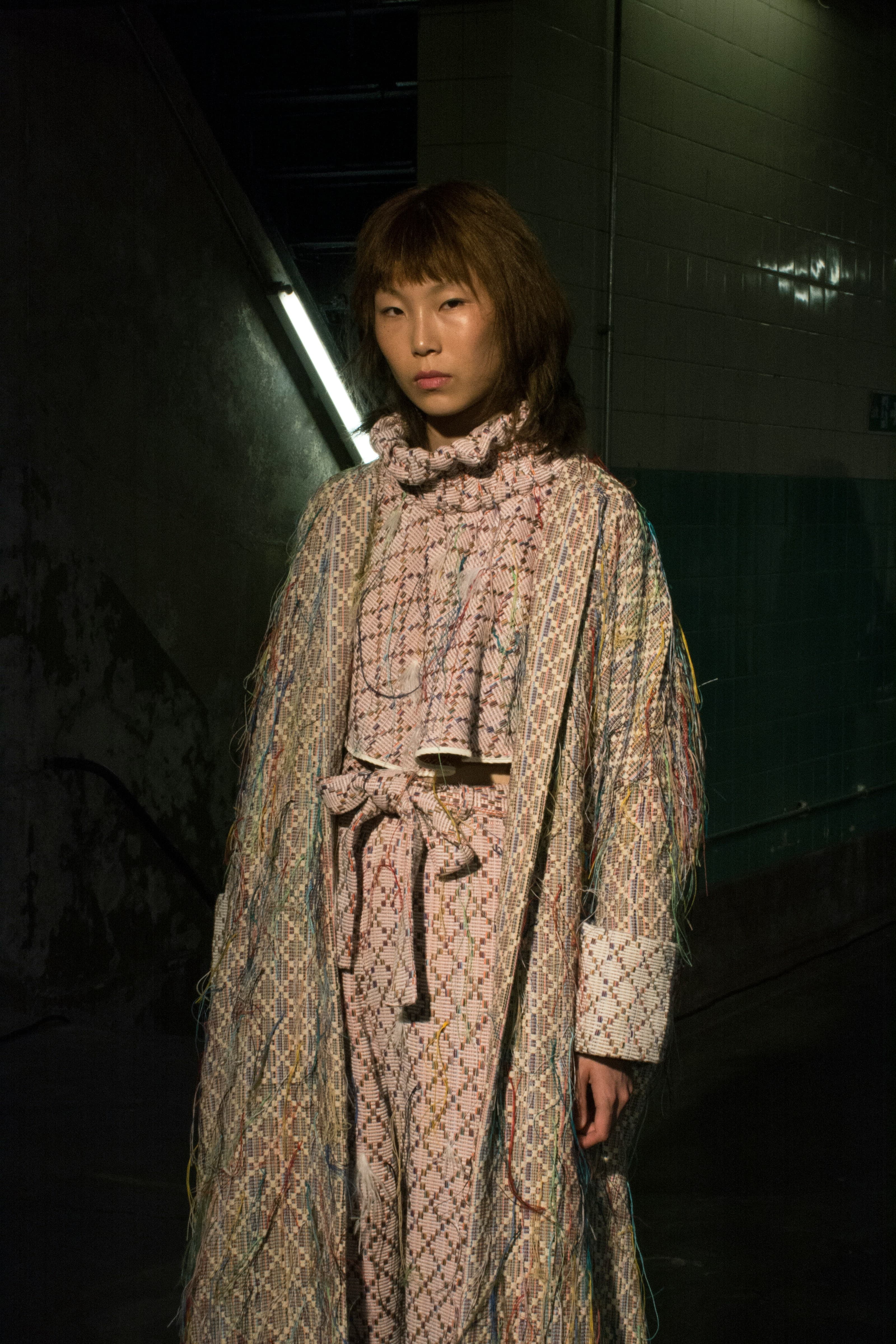
You feel this kind of shift first in the eye, before you have a name for it, before you can explain it to yourself without sounding slightly ridiculous.
A suede bag begins to look less like an accessory than a weather system. A pair of worked jeans, the sort you might once have dismissed as too specific, too adorned, too knowingly themselves, suddenly acquires gravity. Lace stops being decorative background and begins to flicker with something more pointed once it meets a boot with a little weight, a little dust, a little hardness. Leather over softness changes the whole emotional temperature of a silhouette. The outfit does not become louder, exactly. It becomes more alive. More frictioned. More awake to its own surface.
What Maison Première is seeing now, across 769 search trajectories and 195 runway collections, is not the rise of one cute label or another, and not the clean victory of one mode of dress over the rest, but a marked increase in garments with more authorship on their surface and more tension in the way they are worn. Embroidery, suede, lace, sequins, fringe, western hardware, worked denim, contrast pairings, self-style language, all of it begins to gather into a coherent formation. The pieces move in concert. They crest in the same periods. They return in different guises, then reappear with slightly altered force. What binds them is not a named aesthetic so much as a certain density of signal: material you can almost feel through the screen, finish that carries intention, styling that prefers charge to neatness.
That distinction matters.
Because this is not really about dressing “more.” It is about dressing with more consequence. A garment that carries braid, beadwork, visible stitch, suede nap, heavy trim, a difficult color, a slightly wrong boot, a belt that interrupts the sweetness of a dress, does something the smoother wardrobe often does not. It alters the atmosphere around the body. It refuses to behave as supporting evidence. It asks to be read.
There was, of course, a practical seduction to the opposite arrangement. Many women spent the last years building wardrobes that could hold steady under pressure: versatile, repeatable, intelligent, interoperable, pieces bought with a kind of managerial tenderness toward the future. And why would they not. Inflation sharpened the question of value. Fabric quality deteriorated in plain sight. A great deal of the market began offering clothes whose supposed luxury existed less in the cloth than in the label stitched at the back of the neck. Under those conditions, wanting garments that were calm, useful, and well-made was not timidity. It was sense.
But sense has its own limits.
There are days when women do not want to look like finished arguments. They want to look like they have private tastes, private weather, private memory.
That, more and more, is what the data is picking up. At Maison Première, the language of self-style now sits closer to these more authored garments than to capsule logic alone. “Clothes that feel like me” rises from 51.5 to 75.5 over the period measured, from a strong base. “Personal style women,” “clothes with personality,” and “clothes with character” all show meaningful movement alongside embroidered jeans, suede bags, western boots, embellished tops. Not perfectly, not in some crude all-or-nothing way, because fashion does not divide itself that tidily, but enough to say something real: expression is increasingly landing through pieces with stronger material presence, stronger finish, stronger silhouette, stronger contrast.
And the contrast matters as much as the pieces themselves.
One of the more interesting things in the reading is that the garments are not simply rising as isolated objects. They are beginning to read through one another. Boots with lace. Leather with softness. Worked denim with fragile tops. Surface against utility. Romance with abrasion. The styling grammar is not harmony in the soft-focus sense. It is pressure. It is the charge produced when one register rubs against another and neither fully yields. On the runway, the same impulse appears under different names: hard-soft layering, romantic utility, contradictory layering. Different houses, different cities, different accents, but recognizably the same appetite. The industry and the consumer are circling the same idea, though each speaks it in a different language.
Historically, fashion becomes especially interesting when surface stops being treated as excess and starts being treated as meaning. Yves Saint Laurent understood this in 1976, when velvet, braid, peasant fullness, and embroidery ceased to read as merely folkloric and began to read as imperial, erotic, faintly dangerous. Ossie Clark knew that softness becomes more persuasive when it is allowed some risk. Thea Porter made opulence feel inhabited rather than ceremonious, as though trim and drape and saturation were not costume but temperament. Roberto Cavalli, at his most exact, did not merely decorate denim. He altered its authority. He understood that embellishment could make a garment feel less polite, not more.
That is nearer to what is moving now.
Not innocence, but complication. Not prettiness, but voltage.
The important thing is that this formation does not behave like a sugary little social-media frenzy. Its movement is too broad-based for that. Its growth is spread across many terms rather than concentrated in one absurd winner. Its core garment language is relatively low-volatility, steadier than a good deal of supposedly safer styling discourse, which means it reads less like a spike and more like accumulation. The desire is not flashing and disappearing. It is building. It is settling into the bloodstream.
Which may be why the emotional undertone here feels less like rebellion than reanimation.
A great many women are not looking for “statement” in the old cartoon sense. They are looking for their pulse back. They are looking for clothes that can interrupt the deadened civility of getting dressed by rote. And that does not always require spectacle. Sometimes it means a bag with enough depth in the suede to make the rest of the outfit look newly thin. Sometimes a belt with western hardware. Sometimes a worked jean that turns denim from infrastructure into event. Sometimes a dress whose softness sharpens when you give it the wrong jacket. The point is not to become a different person under the pressure of a trend. It is to admit that a wardrobe can become so obedient that the woman inside it begins to disappear.
Competence can flatten into emotional undernourishment.
So the practical question is not whether you should abandon everything pared back, nor whether some neutral foundation has suddenly become obsolete. It has not. The floor remains useful. What changes is what you place on top of it, and how much life you allow the clothes to carry. A wardrobe becomes more persuasive the moment one or two pieces stop cooperating so completely with the rest. The suede bag that darkens the look around it. The lace skirt that acquires nerve in the company of a blunt boot. The embroidered jean that makes every clean staple beside it seem a little too well-behaved. The leather jacket that arrives like a correction, or perhaps like a dare.
This is why the shift matters even if you never intend to dress “bohemian,” whatever that now means, and even if you have no interest in being theatrical. The point is not a label. The point is that certain garments are beginning to carry more force, and women are responding to that force. They are not merely searching for prettier things. They are searching for pieces with enough specificity to reorganize the wardrobe around them. Enough material life to create atmosphere. Enough visible decision to feel inhabited.
That is what Maison Première is tracking now. Not noise for its own sake. Not maximalism as caricature. Not a moral correction to anything that came before. Something more sensuous and more exact than that: a rising appetite for clothes with stronger surface, stronger memory, stronger contrast, garments that do not simply sit inside the wardrobe but change the pressure inside it.
And once you have felt that pressure properly, once you have seen what a single disobedient piece can do to the light, it becomes much harder to go back to dressing as though clothes were there only to behave.
This reading draws on 769 search trajectories and 195 runway collections. Full methodology is documented in Atelier.